What Happens When You Lose a Neutral (Floating Neutral + MWBC Explained)
What Is a Floating Neutral?
Check out our floating neutral simulator!
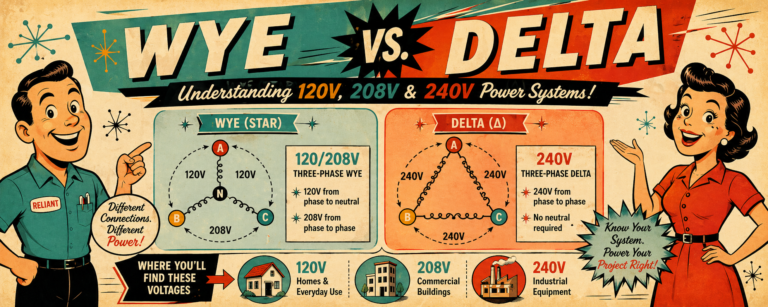
A typical home electrical system has:
Two hot legs (L1 and L2)
One neutral (center tap of the transformer)
The neutral keeps voltage stable at 120V on each leg.
A floating (open) neutral happens when that connection is:
• Loose
• Broken
• Burned up
Without a solid neutral, voltage has no reference point and starts drifting.
TL;DR
A lost or “floating” neutral in a 120/240V system causes unstable voltage.
In normal circuits:
Voltage swings can damage devices
In Multi-Wire Branch Circuits (MWBCs):
The problem gets worse because two circuits share one neutral
Voltage can swing wildly between circuits (60V–240V)
This is one of the most dangerous electrical issues in a home and needs immediate attention.
What Is a Multi-Wire Branch Circuit (MWBC)?
A Multi-Wire Branch Circuit (MWBC) is when:
- Two 120V circuits share one neutral
- Each circuit is on opposite phases (L1 and L2)
When wired correctly:
- The neutral only carries the difference in current
- It is efficient and code-compliant
Common locations:
- Kitchens
- Laundry circuits
- Older homes
Why MWBCs Make Floating Neutrals Worse
When the neutral is intact:
- MWBCs are safe and balanced
When the neutral is lost:
- The two circuits effectively become a 240V series circuit
What happens:
- Voltage splits based on load resistance
- One side drops low (brownout)
- The other side spikes high (overvoltage)
Example:
- Microwave + lights → ~80V
- TV + electronics → ~160–200V
This imbalance constantly shifts as loads turn on and off.
Real-World Signs (Especially with MWBCs)
- Lights get brighter when another device turns OFF
- Lights dim when appliances turn ON
- Different rooms behave differently at the same time
- Devices fail randomly across multiple circuits
- Breakers do not trip
If circuits seem to interact with each other, think shared neutral problem.
Why Breakers Do Not Save You
Breakers protect against:
- Overcurrent
- Short circuits
They do NOT protect against:
- Voltage imbalance
- Open neutrals
So even while damage is happening, everything can appear normal at the panel.
Where This Happens
- Utility service connections
- Meter socket neutral lug
- Main panel neutral termination
- Shared neutral splice points (MWBC junction boxes)
- Backstabbed outlets
- Subpanels with loose neutrals
MWBC failures often occur at shared neutral splice locations.
How Electricians Diagnose It
- Measure L1-to-neutral and L2-to-neutral voltage
- Watch voltage swing under load
- Identify shared neutral circuits (MWBC)
- Check breaker configuration (2-pole or handle-tied)
- Inspect all neutral terminations and splices
Classic readings:
- ~70–90V on one leg
- ~150–200V on the other
What You Should Do Immediately
- Turn off sensitive electronics
- Shut off the main breaker if voltage is unstable
- Do NOT continue using the system
- Call an electrician immediately
This is an urgent condition.
How We Fix It
At Reliant Electrical and Automation Inc., we:
- Determine if the issue is utility-side or internal
- Inspect and repair shared neutral connections (MWBCs)
- Torque and secure all panel terminations
- Replace damaged conductors or devices
- Verify proper MWBC configuration (opposite phases, tied breakers)
- Perform load testing to confirm stable voltage
Local Service (Fresno, Clovis, Madera)
If you are seeing:
- Lights changing brightness
- Devices failing
- Circuits interacting
You may have a floating neutral or MWBC failure.
This is a priority service call.
FAQ
What is an MWBC?
A circuit where two hot wires share one neutral, typically on opposite phases.
Why is an MWBC dangerous with a lost neutral?
Because both circuits become a 240V series circuit, causing voltage swings.
Can this damage appliances?
Yes, overvoltage can destroy electronics quickly.
Will a breaker trip?
Usually no.
This is not a minor electrical issue.
A floating neutral can destroy appliances, overheat wiring, and create a real fire risk — often without tripping a breaker.
If you’re seeing any of the signs above, shut things down and get it checked immediately.
Contact Reliant Electrical and Automation Inc. for priority troubleshooting and repair in the Central Valley.